Dark Matter Matters

45697427. sy475

Black Crouch’s Dark Matter is a tale of “what if” told in grand fashion and with science as the star — what if you had made different choices in life; gone to a different school, chose a different career, fallen in love with a different person?

Dark Matter uses quantum physics to answer the question of what would it be like to live another life. It focuses on a physicist who chose to marry the woman he loves over a career that could have redefined science. But this is only one reality…

Crouch knows how to set up a mystery and focus on what matters. This story could have been derivative of a Christmas Carol or It’s a Wonderful Life, but it puts science front in center to drive a tale that takes the reader through a truly mind-bending experience.

Spoilers:

What does experiencing the multiverse do to one’s psyche? What lengths would shadowy government agencies go to in order to possess the key to traverse multiple realities? How could you control such a technology? All this and more are answered in this science thriller.

Jason Dessen has his life stolen and when he realizes he’s not in his world, he can’t accept this new reality he’s been booted to.

It’s one thing to be lost in a world that’s not your own. Another thing entirely to know you’ve been replaced in yours.

Fake Jason, who went on to figure out how to travel to another reality by unlocking the secret of quantum physics, puts real Jason into his world where FJ’s government coworkers haven’t seen him in about 14 months. Real Jason trusts his instincts not to reveal that they have the wrong guy and he tries to piece together if he’s going crazy. Fake Jason gets the wife he always wanted and has little concern that anything will disrupt this new life.

The thrill-a-minute spectacle kicks off when real Jason escapes in the quantum box into the multiverse with his very own Doctor Who companion, lab mate Amanda, as he tries to get home.

The most beautiful thing we can experience is the mysterious.
Amanda looks at me.
Einstein’s words, not mine.

It’s near impossible to find the grain of sand that represents your world on the beach of the multiverse, but Jason finally figures out to get home you have to think of the world you want. This revelation comes courtesy of Amanda who is thinking of a whiteout snowstorm from childhood and they end up in one when they exit the box. And they almost die that world in sub zero temperatures. A hail mary in the form of a compass that points toward the magnetically charged box helps them find it and uncover it in snow that accumulated over night. They are almost doomed several times and just thinking of your home doesn’t necessarily get you there. You have to be perfectly emotionally in sync with your intentions and feelings.

It’s a troubling paradox — I have total control, but only to the extent I have control over myself.
My emotions.
My inner storm.
The secret engines that drive me.

With little time and quantum juice left, Jason makes the leap home. It gets crazy when other versions of him, who made different destination choices in the box, start showing up and all of them technically have a claim to their wife Daniella. It gets funny scary because all the Jasons know what each other will do so it’s a stalemate. The sole reason chaos doesn’t break out between the Jasons — who are willing to kill each other — is that they don’t want Daniella and Charlie caught in the crossfire. Real Jason tries to think of something he would never do and ends up pulling a funny stunt of smoking in a restaurant and refusing to quit when a cop asks. He ends up in jail and Daniella and him end up together and they flee with Charlie to a cabin north of Chicago. Charlie goofs big time to call a girl and they are tracked down. In a bloody confrontation, fake Jason dies in the cabin and real Jason takes his family to the quantum box in his world so they can escape the others. Many of his doppelgangers are already at the box, but while many are desparate, others are rational, and the family is allowed to pass. To avoid from being followed by a disgruntled double, Jason tells Charlie he’ll be choosing what world they go to live in. The end.

We’re so clearly at the end. Everything we have built — our house, our jobs, our friends, our collective life — all gone. We have nothing left but one another, and yet, in this moment, I’m happier than I’ve ever been.

Bigfoot is real, and really scary

REVIEW

Devolution: A Firsthand Account of the Rainier Sasquatch Massacre by Max Brooks

Max Brooks is in top form with Devolution, his first major disaster thriller after the acclaimed World War Z. I had expectations for the novel, given how stunning World War Z turned out, a tale that cemented itself into the well-worn zombie genre with oodles of sophistication. Like that tale, Devolution is about survival, not just the horrors that tear the world down. It’s about making a gut check and figuring out whether you will fold or fight when society itself crumbles.

The tale is structured similarly to World War Z which was told through eyewitness accounts of a global war. Devolution centers on the recovered journal of one of the characters who lived through the horror of being trapped in the Washington state wilderness after Mount Rainier erupts and cuts off her small eco-community. Surviving the winter becomes secondary to surviving against beasts thought only to lurk in folklore and legend. That’s right, Bigfoot is the boogeyman here, and what the creatures do to this small group of stranded homo sapiens is truly terrifying.

The story is all muscle, no fat – the couple’s arrival to their new home off the beaten path, the introduction of this eco-community as a new sustainable American way of life, the volcano disaster, and then the slow horrifying realization that the wilderness is bigger and darker than they ever imagined.

I love how the story sets the stage with the indictment of society with its willful destruction of the planet so that people can simply maintain their lifestyles. The Green Revolution promises a modern solution that delivers both comfort and sustainability. Americans can’t live without the former before committing to the latter. But we find out soon enough the reality that people can’t make nature adapt to them, they must adapt to it. There’s no middle ground. You adapt or die.

The book asks the reader to decide if the journal is part of a large-scale hoax or the most detailed account ever recorded of Bigfoot, an animal dismissed as the product of crackpot theories over the years. The author then does something even bolder at the risk of losing the reader’s interest – no survivors were found, just the journal, so we go into the story without having even the hope of an ending where the people we read about are still alive.

Without spoilers, there’s a reason for this, which I found out at the end, and Brooks brings it home full force with a satisfying conclusion.

The book’s title is clever and speaks to why Bigfoot hides and thrives still today, and the regular interludes in the book describe actual recorded behavior of primates in the animal kingdom. This lends credibility and creepiness to the horrors that play out. This book immerses you if you let it, and it serves as part cautionary tale, part survival guide, and part character study on society and what we individually are really made of.

I highly recommend it, especially to fans of Brooks’ other survival work, and for those who want to make that gut check.

The Spoilers. You’ve been warned.

Brooks sets up the narrative arc with creepy foreshadowing. There are interludes where experts describe certain animal behavior. You get one description of chimpanzees hunting in packs and disemboweling smaller primates. Gruesome and it lets you know what’s coming.

Brooks knows how to introduce the horror in slow drips. I remember the first encounter Kate, the protagonist, has with a Bigfoot. She thinks it’s a boulder in the middle of the road:

Then I saw the rock move. It shifted in place, grew, then disappeared behind the trees. I also thought I saw it change shape, lengthen, narrow, even spread out limbs like a tree. Arms? I rubbed my eyes, blinked hard.

Fast forward to some truly tense showdowns when there is no longer any doubt that these creatures exist. The sasquatches mangle one human to draw out the others and then when it fails, they, in horrific fashion, tear the man apart.

One of the monsters’ key tactics: rocks as artillery. The houses take a beating when cantaloupe-sized rocks shatter the mostly glass walls of the homes, exposing the humans even more.

The Alpha turns out to be a female, a monster behemoth, gruesomely scarred and relentless in her pursuit of her prey. All the other sasquatches show absolute deference to her and when she kills the community’s founders, it’s a squeamish scene that strikes a primal fear in you.

Kate claims her own status as the alphas of the human survivors when trapped in a bathroom, close to imminent death, she wraps a towel around her hand and lights it on fire just as the Alpha sasquatch shatters the bathroom door to make Kate her next snack. Kate punches her, putting her fist straight into the beast’s mouth for a barbeque surprise. Truly badass.

At the same time the humans use what was once a weakness with the glass exteriors to create a minefield of shattered glass to slow down the predators from getting to them inside.

It almost works but one of the bravest characters doesn’t survive a one-on-one showdown with a beast. Mostar is a survivor of ethnic cleansing in Bosnia and she is the catalyst to get this American group to act early once she understands they are being stalked by something unnatural. At her end, she draws the beast in and stakes it through the heart as it smashes her with the weight of its lunging body.

There’s a lot of tactical play that takes place throughout the third act, and it’s absolutely delicious. The final showdown is screen worthy and plays out in vivid technicolor ultraviolence. Kate embraces her leadership role and the group makes an Alamo-type last stand where the humans finally unleash their inner killer instinct and bring to bear everything they have in their arsenal of homemade weapons and traps in a gambit to outlast the bigger, stronger tribe. It’s bitter to see the humans fall one by one in this battle of attrition, but there’s the knowledge that this is the only way. It’s truly a contest of survival in the basest sense – kill or be killed.

Kate’s boyfriend Dan is gruesomely stomped to death by Alpha after his melee attack with his custom coconut knife misses her heart, but Kate hurls herself at the beast in the very next heartbeat. Using her aluminum-covered shield to distract the monster, she drives “the Damascus blade through skin and muscle, heart and lungs.” It finishes off the matriarch and solidifies victory for the humans, all two of them.

In the epilogue, Brooks plants the seed of an idea in your head. We don’t actually know if Kate and her now surrogate daughter Palomino survived the winter that followed – we only have Kate’s recovered journal – but the narrator suggests several theories, the most interesting that some primal instinct took over Kate and she made it her mission become a predator herself and hunt down the remaining sasquatches so that those horrors would never come back. So, yeah, she’s somewhere in the wild, a stone cold killer of Bigfoot. It’s chillingly good and fits right into this tale of survival of the fittest.

4.5 of 5 stars.

– Josh

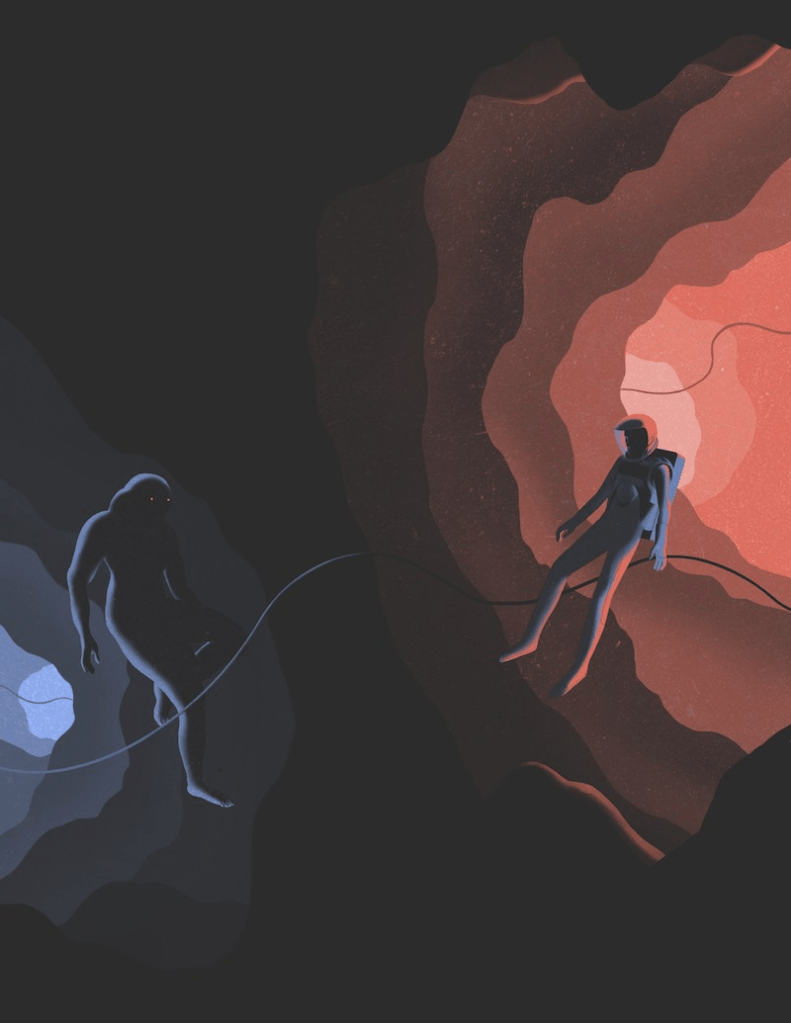
Social Divides in the Solar System

illustrated by Jun Cen

Try turning off all the lights at night, moving through your house in total darkness, through interiors where no ambient light reaches, feeling your way down familiar hallways, counting the steps on the stairs until you reach the landing above and moving deftly around corners as the walls guide you. I did this as I went from my basement reading spot to bed, getting a sense of the life Chocky lived, with only four senses instead of five. But I did this only, as the author of the story might put it, in a touristy sort of way.

The Tourist” by Alex Sherman (on Tor.com from free) creates a world that more than sufficiently immerses you in its scant 16 pages; it feels plausible. Just like in James S. A. Corey’s The Expanse series, moving out into the solar system creates social divides, haves and have-nots, and the Morlock-like denizens in the belly of this hostile far-flung rock in the desert of the solar system are at once fascinating and pitiable.

The tourist is studying for a Ph.D., hoping to learn more about what is essentially a lost civilization deep in the Amazon forest of the stars.

Like any speculative fiction of note, this story turns the reader’s expectations upside down in the best of ways. The tourist can’t see what’s going on (literally) and is dependent on the local guide to help find what he came looking for. But Chocky isn’t just introduced as a device to help the tourist along – he has his own needs, desires, and fears.

The tourist only has a short time to be with the moles/Squatters (as they are called), but in that period he discovers more about the society than any before him, and perhaps gets more than what he bargained for.

This story could be allegory for how we might treat whole segments of society — whether it’s Blacks, the poor, the elderly — and ignoring their pain and suffering, conveniently placing it in the dark. Or perhaps that’s just me projecting in the time of covid-19 and social unrest after the murder of George Floyd by police.

Either way, I can see myself as being both the disenfranchised and the privileged — Chocky and the tourist — and wondering that if their roles were reversed, would things be any different.

4 of 5 stars

Josh

Opposing the Devil Requires Plan A, and Plan B

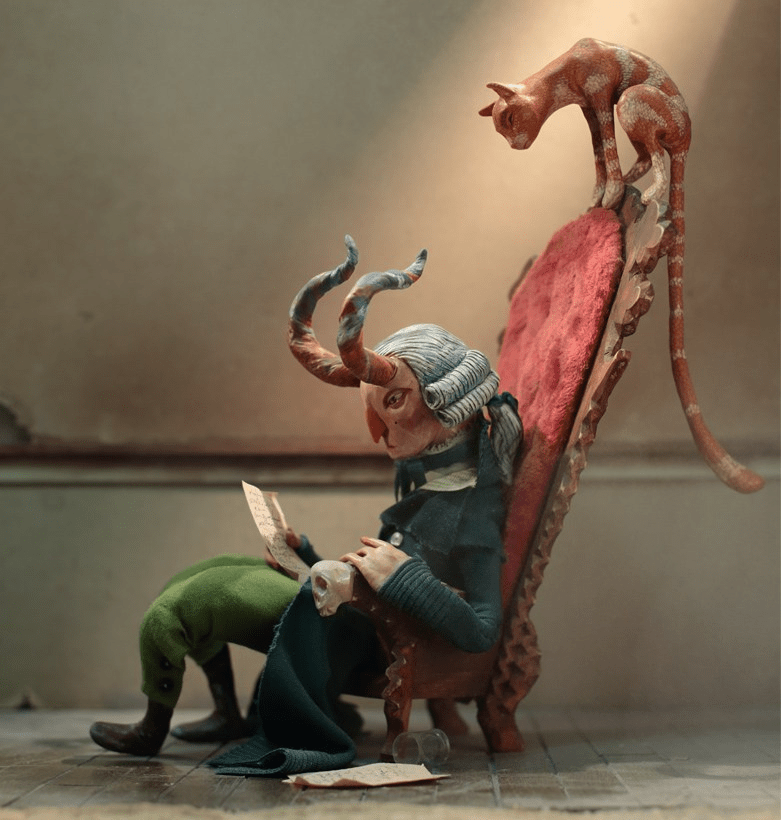
The Hugo-nominated novelette “For He Can Creep” by Siobhan Carroll is a riot. The opening scene sums up the hijinks readers can expect:

“The whole asylum is his, and let no demon forget it! For he is the Cat Jeoffry, and no demon can stand against him.”

The story is brimming with personality, and I love its layers of depth told in a simple fashion from Jeoffry’s perspective. I don’t have a cat, but I’ve seen enough America’s Funniest Home Videos to know the author captures feline habits and quirks perfectly. 

Jeoffry has no equal and can smite imps and chase down devils who would dare oppose him or torment his human owner. That is until he comes up against Satan. It is nothing short of a battle for the soul of humankind and it’s up to Jeoffry to resist the devil’s temptations and outwit the father of lies. It gets hysterically good. 

When you’re done, you won’t soon forget Jeoffry and his human. And of course, there’s “NIGHTHUNTER MOPPET!” along with cursing cats. 

5 of 5 stars.

Read for free at Tor.com: https://www.tor.com/2019/07/10/for-he-can-creep-siobhan-carroll/

– Josh

Messing With Time Is Just Complicated

Spoiler-free review.

Blake Crouch creates a compelling time-bending story that keeps readers invested and guessing all the way through. It takes a disciplined mind to bring to life a story where the implications of time travel are thoroughly considered and brought to life in vivid fashion.

Every change in the timeline wreaks unintended consequences (but that’s every time travel story). Then the characters get a shot at resetting and fixing things (again, every time travel story).

But the fashion in which Crouch shapes these tried and true tropes is brilliant and beautiful. It’s a heart-breaking tale of hope, regret, and sacrifice.

Recursion lives up to its name (and book cover art) with a never ending loop of ‘what ifs’. It’s tight, complex, and demanding of your attention.

The experience is immersive too. I was trying to play out the scenarios along with the characters, working through the implications of messing with the past. But I was helpless, as the characters are, when the best laid plans fail.

Many stories falter or stumble in the third act, but Recursion shines, bringing our protagonists through harrowing trials and never taking the easy way out. This story is extremely good and could sit firmly in a top 10 list of time travel stories in any media.

5 of 5 stars

– Josh

The Beginning of the Murderbot Diaries is Unexpected and Entertaining

Ok, this was a welcome distraction and promising introduction to a great character, the murderbot.
This is a novella that goes by fast and has echoes of Alien and Lost in Space. The action is brief but highly entertaining (“This is how we fight: throw ourselves at each other and see whose parts give out first.”) and the story spends its time letting us get to know this cyborg killing machine from a first-person perspective (It’s called the Murderbot Diaries). Saying anything about murderbot or its personality would be spoiling about 80% of the fun.

The story generally is about murderbot’s perception of humans and what it wants for itself. The story hinges on you caring about murderbot, which it succeeds in, with wry humor, inner monologues that are laugh-out-loud, and the portrayal of the bot’s progression toward trusting the humans.

It’s all too brief and the ending is just satisfactory for me. I loved how murderbot shined as the hero but the last major action scene felt clipped as the reader moves to the feel-good end. But I’m looking forward to more of this character in the next adventure.

SPOILERS:

A story about a bot that is about as shy as the most introverted human, loves its day-time TV shows, and is indifferent to its job (the Company buys the cheapest parts, and it makes for crappy working conditions). I got to say, this was the last thing I was expecting from this story, but it’s hilarious.

The humor: “Yes, talk to Murderbot about its feelings. The idea was so painful I dropped to 97 percent efficiency. I’d rather climb back into Hostile One’s mouth.”

The pathos: “Maybe this was how murderbots died. You lose function, go offline, but parts of you keep working, organic pieces kept alive by the fading energy in your power cells.”

The action: The above quote about running into battle and see who gets shots up the most and fails first.

The drama: “You have to kill me.” (tear jerker).

Making a friend: “My insides melted. That’s the only way I could describe it. After a minute, when I had my expression under control, I cleared the face plate and had it and the helmet fold back into my armor.”

Being a badass: “You used combat overrride modules to make the DeltFall SecUnits behave like rogues. If you think a real rogue SecUnit still has to answer your questions, the next few minutes are going to be an education for you.”

I loved the ‘moment’ when the humans have to figure out why Deltfall is all dead, and if they can trust their murderbot, who they now realize has been a hacked bot with free will the whole time. Murderbot leaps off the bed and grabs the augmented human by the throat. Hubsystem had lied to the humans and said murderbot was immobilized, but it wasn’t and it still chose not to hurt them (aside from this little demonstration for the one guy it didn’t like.)

Yes, I envisioned this bot as a female (even though it’s asexual) and the main reason the story holds up is how humorous the bot is. This is a Hugo- and Nebula-Award winning novella, which I didn’t know going in, and I’d honestly say without the main character being as intriguing as she/it is and the growing connection she has to her clients, the plot would be kind of generic. But that didn’t detract me from being entertained by this neurotic, sometimes heroic, binge-watching little bot.

4 of 5 stars.

Now off to more adventures with murderbot!

-Josh


The Perfect Story Collection? ‘Exhalation’ Astounds with its Look Into the Human Soul

Exhalation1

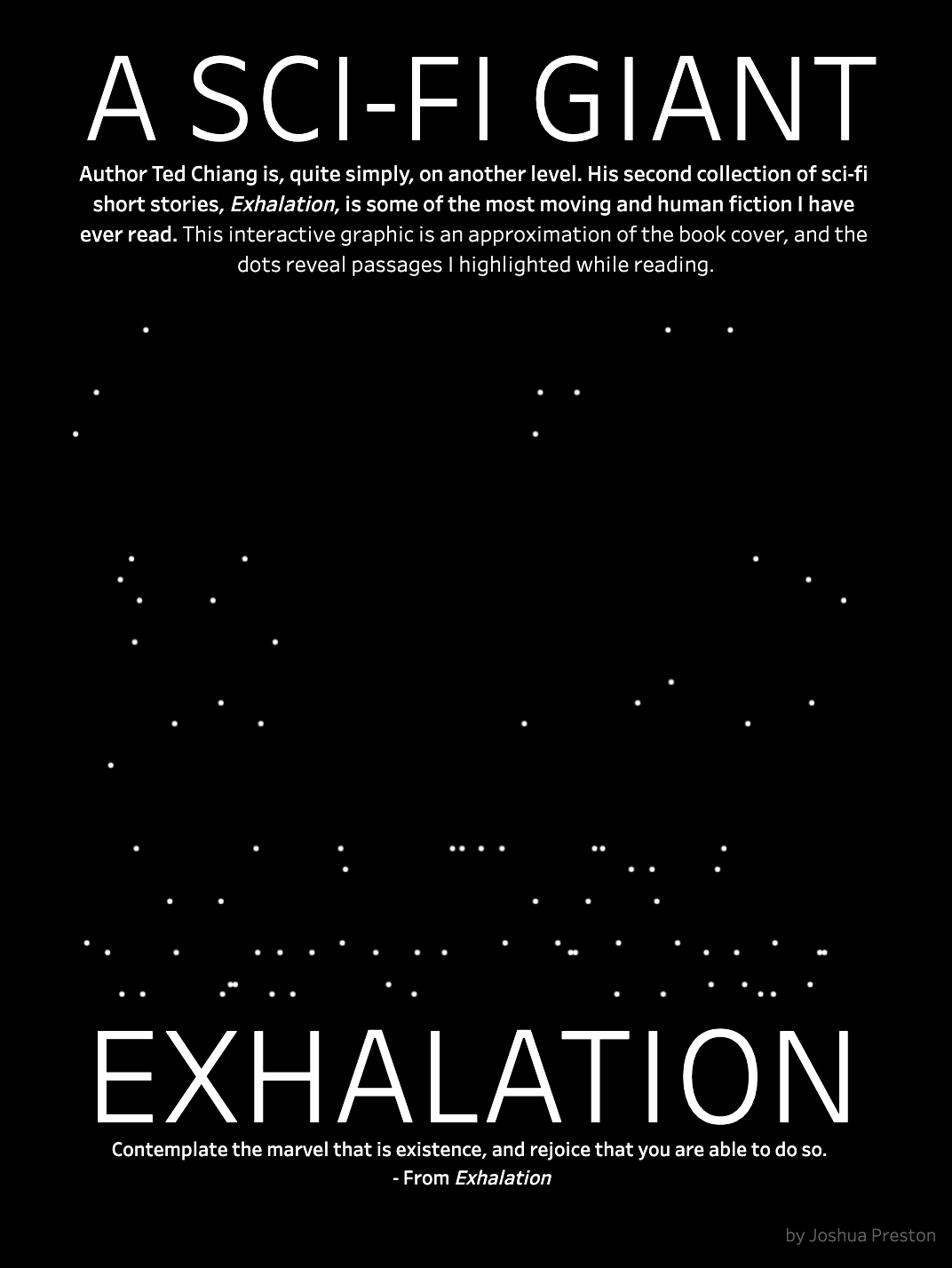
Click image for interactive version. Most stories are less than an hour, and it’s time well spent for seekers of not just great, but essential speculative fiction.


Exhalation isn’t just a collection of short stories, it’s an experience that you will revisit over and over in your mind. I’m still processing the issues it raises about technology, society, and our collective and individual free will. It’s hard to put into words how profound the ideas, and the execution of those ideas, are.

Again, it’s an experience.

Story collections can sometimes be hit or miss and they are only as strong as their weakest link. There are none here. Ted Chiang wrote the stories in this collection, his second, over the course of almost a decade and a half (2005-2019). They all feel timeless, distinct, and something that is experienced at a personal level.

I’ll argue that these stories do what the best sci-fi should do, and then some. Science fiction allows people to potentially be more open or exposed to ideas that they otherwise wouldn’t be. Exhalation checks that block and then does something even more rare – it gets you thinking about changing your behavior, about being a better citizen of the world, and by doing so, moving the needle in the right direction.

Happy Reading!

Josh

exhalation2

Recreation of the book cover. Click image to interact.

A Compelling City on Water Filled with Staggering Human Misery

Splendidly spoiler free review.

Blackfish City is an extraordinary piece of fiction. Sam J. Miller is able to build a world, immerse readers in it, and make them marvel at its strangeness and decaying grandeur. The mysteries that surround the water city of Qaanaaq — its history, technological wonders, and status as the envy of the Sunken World nations — set a riveting stage for the book’s cast of deeply scarred and fascinating characters. The narrative itself is expertly paced and written, giving each character a depth that makes you almost feel their anguish and understand the desperation of their lives in Qaanaaq.

The social and political subtext that is a hallmark of every great piece of speculative fiction is abundant in Blackfish City and often made me think of contemporary parallels without ever beating me over the head with an agenda. It opened my eyes to broader perspectives about different lifestyles, the fallibility of human systems, and the absolute corruption of the soul when survival becomes the only goal.

This book tries to deliver the entire package in a single tale – authentic world, fully-realized characters, compelling narrative, social commentary, unique fantastical elements – and I think in large part it succeeds. I appreciate immensely an author being able to bring a story to life within a single novel and deliver on all these elements. It’s a testament to being able to enthrall readers and give them a story that stays with them, moves them in some way, and becomes a meaningful part of their love of the genre without them having to commit to a ten-book series. *cough* Game of Thrones *cough*

Qaanaaq is a scary place, and it echos the dead nations that preceded it in many insidious ways that aren’t immediately apparent. The squalor and social divides are all the proof that’s needed that the computer programs that run the city are no better than their human programmers. It was absolutely chilling to think that the most ruthless of the old world could rule the new one and use anonymity and hide behind the so-called benevolent computer programs to keep a stranglehold on what was left of the world’s wealth.

Qaanaaq is seen as a successful model forward as the world floods or burns, but those who make it to the floating city find only temporary relief. There is barely enough space for the population, many residents crammed in closet- and box-sized living spaces. A deadly disease the breaks, is sweeping the population and a phantom of the old world, bent on vengeance for the genocide of her people, has arrived.

My favorite parts? Slight spoilers start now…

I was a big fan of Ankit and Kaev. They are both tragic characters, but survivors. Miller isn’t afraid to shatter his characters and it was devastating to see how short lived some of their happiness was. Joy has been in short supply their whole lives and I had a hard time when I realized that part of their tale would not end well.

There is so much sorrow in this book, and Ora and Masaaraq represent the core of this. Their story is arguably the center of the narrative, and they are determined to persevere no matter what. They are symbolic of an older generation under siege but with the strength to help those who come after them. They could represent the philosophy of yin and yang, one fiercely loyal to blood family, the other committed to the human race achieving more harmony.

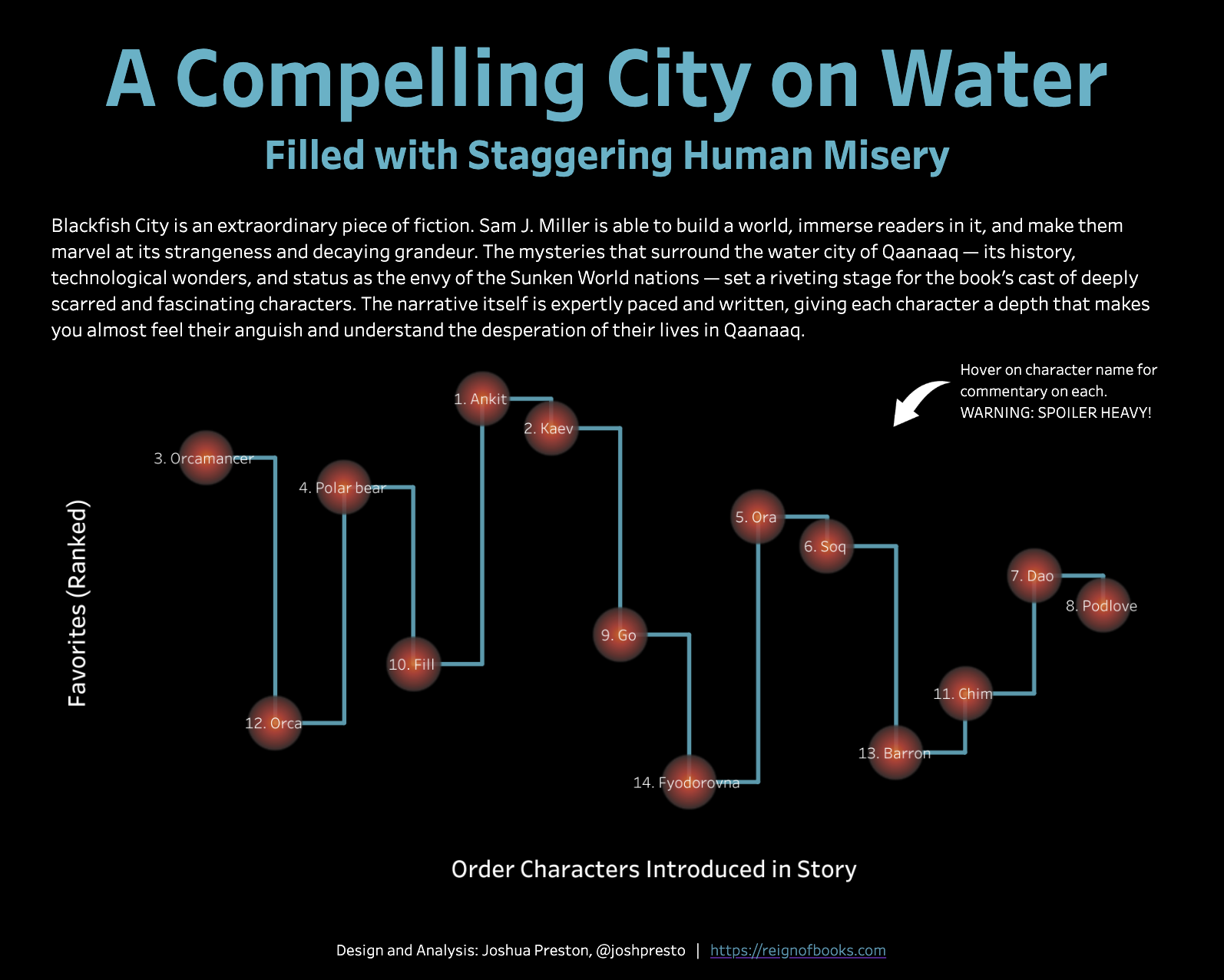
To get a quick take on all of the book’s main characters, check out my data visualization. It shows the order characters were introduced in the book and a ranking of my favorites. For those who want spoilers, hover on the dots to see some of my analysis of each character. DON’T hover on the dots if you don’t want want spoilers!

4 out of 5 stars (I wish the third act hadn’t been so rushed.)

Happy Reading,

Josh

Blackfish City

Click image to interact


‘Artemis’ Review: Jazz, you’ve been a bad, bad girl.

Image result for artemis book coverThe book Artemis by Andy Weir is like the flavored algae that the moon colonists in the story eat, passable but it’s no gourmet meal. No matter how much chicken flavor you put on the algae (known as Gunk to the locals), it’ll never be the real thing.

As much as I wanted to love this book, and as many laughs as I had with it, it was an exercise in frustration because of its unevenness. Its highest of highs – corporate sabotage, hilarious inner monologues, “sciencing the s#&*” out of any Martian lunar problem – were stifled by flat characters, horrible dialogue, and a third act, that while entertaining, warp speeds to a tidy convenient conclusion.

Like the book’s liquor, food, and air, the story feels reconstituted or recycled from Andy Weir’s acclaimed debut novel “The Martian”. That’s not necessarily a bad thing, since the reader is treated to several survive-or-die scenarios in this book like those found in the other.

Jazz Bashara, our smuggler and supreme smart-ass, is the most well-developed character with plenty of laugh-out-loud moments, but as far as her character arc, it could be summarized as “hustle harder to make more money and move up to a nicer moon apartment.” Her current living arrangement is nicknamed the coffin for its size.

The story attempts to depict a frontier town on the moon, but the handful of half-dome structures that make up the town along with a desolate moonscape are the entire setting. Realistic, maybe, but it’s a bland backdrop that doesn’t really feel complete.

The story at face value is a cool concept with heartwarming moments and some great MacGyver on the Moon situations, but the character relationships are uneven, which made me care only half the time. (I liked the dad, Dale, and Svoboda, and others grew on me (Ngugi, Rudy), but others were wasted (The Landviks, Sean, Chu, Sanchez, Bob).

The good stuff? Weir is extraordinarily strong in his science writing and weaves it seamlessly into the narrative, making for fun action scenes that are the life of this tale. I’m glad to have read it just for these moments: Sabotaging a moon rock harvester in an EVA suit where one screwup means death? Check. Using a remote control bot to illegally open airlocks for you? Check. Putting out moon fires, starting moon explosions, and rolling your moon rover to escape said explosion? Check. The finale, which I won’t ruin, is nuts and satisfying – it creates a true heroine out of Jazz.

I recommend reading this for the fun of it and getting an idea of what you can expect as a tourist on the moon (no drinking age!). Don’t let the shortcomings prevent you from taking this wild ride. Verdict: 3 of 5 stars

Bonus: Poking fun at “The Martian” – “Only an idiot relies on duct tape to maintain a pressure seal, but I didn’t have a choice.”

Favorite Quote:

“The trick with Gunk is to steer clear of stuff trying to taste like other stuff. Don’t get the “Tandoori Chicken” flavorant. You’ll just be disappointed. Get “Myrtle Goldstein’s Formulation #3.” That’s good s*&%. No idea what the ingredients are. It could be termite carcasses and Italian armpit hair for all I know. I don’t care. It makes the Gunk palatable, and that’s what matters.”

Happy Reading!

Josh

A Pitch Perfect Sci-Fi Short That Speaks Volumes

Emergency Skin (Forward collection) by [Jemisin, N. K.]

The best fiction keeps your undivided attention. It holds you in the moment, simultaneously letting you savor every word and creating anticipation for what happens next.

N.K. Jemisin’s short story “Emergency Skin” does these things and more. The story of a human foot soldier on a mission to a decimated Earth is almost immediately flipped on its head. The Earth is thriving when it shouldn’t be since the ‘best’ of the species hightailed it off-planet with as many resources as possible centuries ago when they saw everything circling the drain. Everyone else be damned.

Jemisin cheekily uses the AI embedded in the soldier’s suit to show how wrong our ‘superior’ cousins got things. The planet survived the catastrophic damage that people inflicted on it and society didn’t crumble. We rebuilt.

The story could almost be a standup comedy routine (the audio story is excellent) the way it’s delivered and how exasperated the AI is at not being able to explain things.

But Jemisin does something more here than entertain; she creates multiple layers speaking basic truths about civility and compassion without beating you over the head. It ultimately made me reflect deeply on how we think we have the solutions to everything and he we might be deeply flawed in some of these assumptions.

It’s hilarious, it’s thoughtful, and it shows Jemisin at the top of her writing game.

(Part of the Amazon Prime Reading collection “Forward“)

Happy Reading!

Josh