The Road review: Bleak, Depressing, and Utterly Devoid of Hope — How the End of the World Really Looks

The 2006 Pulitzer-prize winning novel “The Road” by Cormac McCarthy is bleak, by any standard of the definition. If you want a glimpse of what the post-apocalypse really looks like, you’ll find it here. The story focuses on one man and his child wandering on a road south to escape the cold in a gray ruined world with a sky that never shows the sun or stops raining ash.

The world that once was will never be again. In the aftermath of the apocalypse there is no wildlife at all, and humanity is slowly nearing extinction as cannibalism becomes the norm. Those few details exist to let you know how hopeless the world is, but the central struggle is a father trying to keep his son alive and to find some meaning beyond the stretch of road he can see in front of him.

I would contend that this is the alpha of post-apocalyptic novels. There’s no respite from the natural elements and human dangers in a world that’s edging to oblivion.

There were few nights lying in the dark that he did not envy the dead.

The story puts the reader right into its world. One example is the bitter relentless cold. I can remember back more than a decade to a nighttime Army exercise in winter with “cold to crack the stones,” to borrow a phrase from McCarthy. I can’t imagine living day-to-day not being able to get warm and being perpetually miserable.

They went on. Treading the dead world under like rats on a wheel. The nights dead still and deader black. So cold.

There’s a moral compass that the father tries to stay true to, and it’s his son that likely keeps him from giving in completely or to his darker nature.

What makes this book rise above others of similar ilk is the relationship and the conversations that the boy and his father have. What they talk about and how sparse their conversations are hit exactly the right tone for this world. There’s not much to talk about and they have very little energy to do it. The story is pure in the sense of a father and boy being able to rely on each other and live only for each other, and that in itself has some haunting beauty, despite the father knowing that they are on borrowed time.

Then there’s the gallows humor:

What’s the bravest thing you ever did?
He spat into the road a bloody phlegm.

Getting up this morning, he said.
Really?
No. Dont listen to me. Come on, let’s go.

Every decision they make means life or death. Living that way for years on end would tear down even the most resilient of people. The father desperately needs to get his son to the coast, someplace warmer, but then what next? That’s a question he himself does not have an answer to. Don’t expect a traditional narrative arc where you’re given the answers at the end. I think the story, at least for me, is part fiction and part study for reflecting on your values.

The frailty of everything revealed at last. Old and troubling issues resolved into nothingness and night.

I learned a lot from “The Road” — examining more closely what I have in life, the resilience of the human spirit, the fragility of the world, putting relationships first, and not giving in to your darker self, to name a few.

The novel is bleak, depressing, and utterly devoid of hope, but that’s what the end of the world really looks like.

5 of 5 stars

-Josh

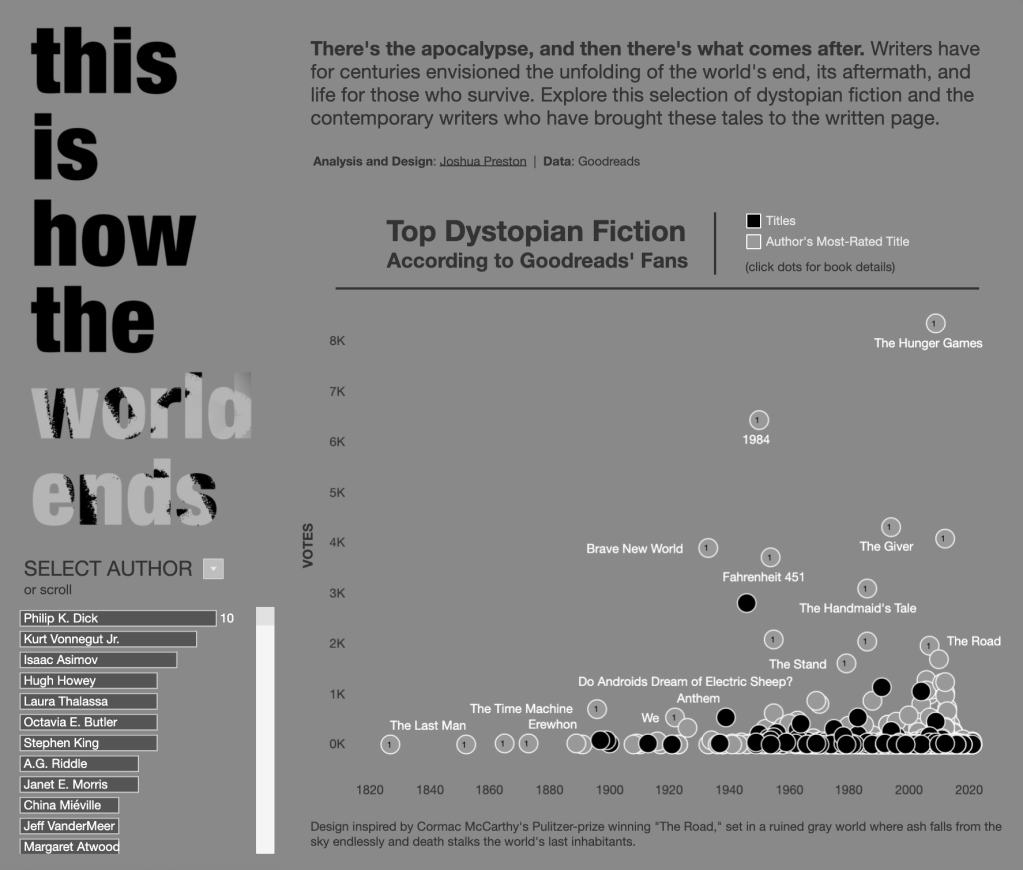
p.s. I did an analysis of votes by Goodreads’ fans for top dystopian fiction by creating an interactive graphic. Design inspired by “The Road.” Check it out.
Paul Tremblay is at the Top of the Horror Heap for a Reason | Survivor Song Review

Survivor Song

One of my standing rules when writing book reviews is no spoilers up front. Half the garbage on the Internet launches right into telling you what the book is about. If it’s not in the description, I don’t wanna hear it. Survivor Song by Paul Tremblay might be the exception to this rule. But let me at least try the traditional spoiler-free approach first:

I went into this book knowing exactly zero about what it was about. (I didn’t even read the description). I just heard Paul Tremblay was at the top of the horror heap, so I said “why not?” I was not disappointed.

This is a story about an epidemic, potentially world-ending stuff in the form of a virus left unchecked. With all the chaos, no one knows what it is. Zombie invasion, biological warfare, super rabies? But what caught me almost right away was this feeling that this…could…really…happen.

It didn’t feel like a piece of fiction where I was safe to observe. Putting myself in the characters shoes terrified me because the story was just this side of plausible.

The author was stingy with details, and it served to create this uneasy feeling where, as with the characters, you don’t have a complete picture of what’s going on. The wave of internet noise and news reports starts to cause more chaos and despair, accelerating the decline of civil order.

This story made me feel connected to other people and more empathetic, which might be one requisite for success. I think a more important achievement is that it brings together many lessons we could learn in our current pandemic with COVID-19.

SPOILERS

There is tremendous loss throughout this story, and it doesn’t feel like characters, but rather actual people who are dying. It was a bit hard to read it in that regard. But at first, with no idea what I was getting into and dutifully plugging through the opening scene with pregnant wife Natalie waiting for her husband Paul, it was a bit of a yawner. I thought these were the extras about to die horribly to establish how scary things are before moving on to the main characters. My expectations were immediately flipped on their head and we find Natalie — who in fact loses her husband from a man-gone-mad biting and bludgeoning him to death — driving frantically through Boston to find her best friend, who happens to be a doctor. Natalie has been bitten and needs help before she becomes a rabbid mindless vegetable. The atmosphere feels authentically creepy because what we’re dealing with is a super rabies and the city is essentially infested with rabbid mammals of all kinds that succumb to the disease within hours.

There are parallels to the current COVID-19 crisis but it could also be a timeless story about certain groups of people who are in denial about the scale of the crisis or conspiracy theories running rampant and the breakdown in the system, whether it’s government services or social order. And you ultimately see, like in any situation where fear and chaos rule, people die unnecessarily. So there’s that subtext, but it doesn’t beat you over the head or get in the way of the narrative focus, which is the relationships and encounters in the journey.

Many characters in the book think that this is the end. A real zombie invasion. Or a deep state government conspiracy to release a virus and then make money off the vaccine. Take your pick.  While some kids think they’re fighting zombies and go looking for trouble, you have rational adults trying to reason with them and let them know that things will be OK. There’s a lot packed into the relationships between the two sets of best friends who meet up (the two adolescent boys and Doctor “Rams” and Natalie ). I love the kids because they’re dropping pop culture references and movie quotes and it’s just hilarious to see how they basically, like all youth, think that they’re young and indestructible. They reference zombie movies and the tropes in the genre, notably how the heroes come across random people or “randos” who eventually die. It’s a bit of clever foreshadowing about the boys, who think they’re the heroes, but who ultimately don’t make it. Their demise is a particularly somber section of the story.

The quartet comes across an animal control posse that basically is looking to kill all the pets in the neighborhood, and that goes horribly wrong. This is when one of the boys gets bit by a relentless coyote that tracked Rams and Natalie in the ambulance. Rams has to get Natalie to a safe hospital to deliver the baby, and they part ways with the youth, who go into the woods and accept their fate, with the healthy boy choosing to share the same end as his friend. They battle wild rabbid animals and when the infected friend attacks, the other boy chooses to evade and not fight him. In the end they both go quietly into the night.

So the women’s relationship and the realization that Natalie won’t make it takes on this urgency as they focus on making sure Natalie’s baby has a fighting chance at life. Natalie tries to hang onto this fragile hope of having a child, knowing full well that she will herself die. She begs Rams, who doesn’t want a child even of her own, to promise to be the baby’s caregiver.

In keeping with the book’s you-feel-like-you’re-there feeling, at the very end when Rams has to somehow subdue Natalie, who has “turned,” it’s truly a tragic and arresting experience that will define the rest of Rams’ life. The actual medical procedure of a C-section to try to get the baby out alive is told with great detail so you feel like a doctor who has a person’s life in your hands. It’s a visceral experience and a climax that effectively caps what has become an emotionally draining experience for Rams and the reader. Kudos to Tremblay for this final nailbiter sequence. The baby isn’t breathing when the doctor finally delivers the child, and it’s not until 10 years later in the fast forward epilogue that you find out that little Lily did make it and Rams has tried to honor her friend’s request by raising the daughter.

I loved this apocalypse/not-apocalypse tale. The fact it was written during a real-life pandemic helped me experience it through a different, more empathetic lens. It’s a tightly written, emotionally anchored read that shows you the human side to pandemics and perhaps reminds us to never forget what we’re really fighting for. 4 of 5 stars

-Josh

Sci-Fi Nominees, and a Winner, from the Goodreads Choice Awards 2020

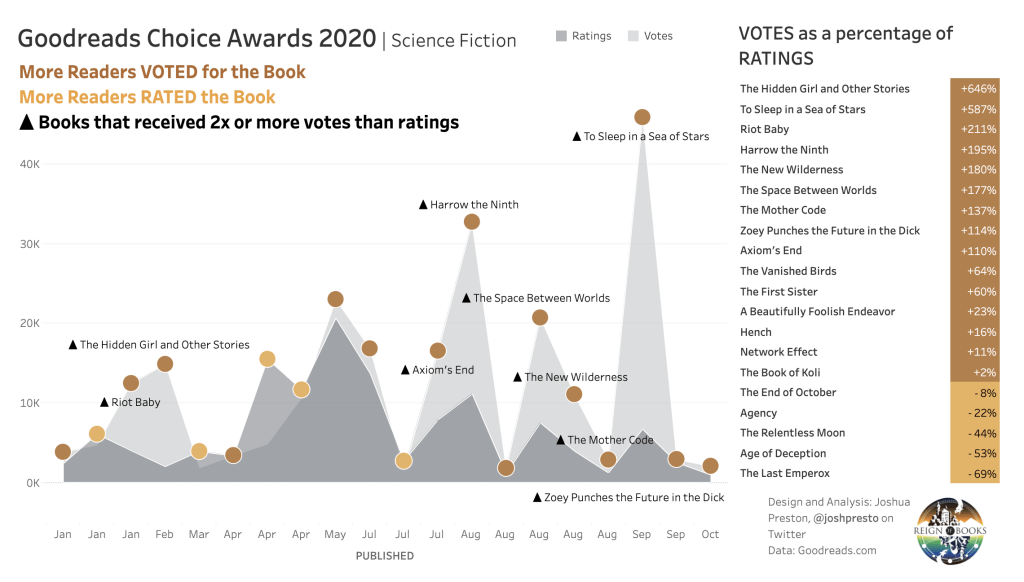
So what book tallied the most votes in the Goodreads Choice Awards 2020 for science fiction? (The winners were announced Dec. 8.) I think a much more interesting question is “How did the number of award votes compare to the lifetime ratings for each book?” Well, it’s not hard to browse and find out, but I wanted to do a more direct comparison and see how books published across the year stacked up.

Fans of books published in the first quarter remembered their love and came back to vote for Q1 books (Riot Baby and The Hidden Girl and Other Stories). Midyear books (April-July) were strongest for both lifetime ratings and award votes. But the books that faired the best for voting season came out in August and September. Three of the four books with the most votes had at least twice the number of votes as lifetime ratings and were published in August or after. These include Harrow the Ninth, The Space Between Worlds, and the genre’s award winner To Sleep in a Sea of Stars. To see book details, explore the interactive data graphic. – Josh

Dark Matter Matters

45697427. sy475

Black Crouch’s Dark Matter is a tale of “what if” told in grand fashion and with science as the star — what if you had made different choices in life; gone to a different school, chose a different career, fallen in love with a different person?

Dark Matter uses quantum physics to answer the question of what would it be like to live another life. It focuses on a physicist who chose to marry the woman he loves over a career that could have redefined science. But this is only one reality…

Crouch knows how to set up a mystery and focus on what matters. This story could have been derivative of a Christmas Carol or It’s a Wonderful Life, but it puts science front in center to drive a tale that takes the reader through a truly mind-bending experience.

Spoilers:

What does experiencing the multiverse do to one’s psyche? What lengths would shadowy government agencies go to in order to possess the key to traverse multiple realities? How could you control such a technology? All this and more are answered in this science thriller.

Jason Dessen has his life stolen and when he realizes he’s not in his world, he can’t accept this new reality he’s been booted to.

It’s one thing to be lost in a world that’s not your own. Another thing entirely to know you’ve been replaced in yours.

Fake Jason, who went on to figure out how to travel to another reality by unlocking the secret of quantum physics, puts real Jason into his world where FJ’s government coworkers haven’t seen him in about 14 months. Real Jason trusts his instincts not to reveal that they have the wrong guy and he tries to piece together if he’s going crazy. Fake Jason gets the wife he always wanted and has little concern that anything will disrupt this new life.

The thrill-a-minute spectacle kicks off when real Jason escapes in the quantum box into the multiverse with his very own Doctor Who companion, lab mate Amanda, as he tries to get home.

The most beautiful thing we can experience is the mysterious.
Amanda looks at me.
Einstein’s words, not mine.

It’s near impossible to find the grain of sand that represents your world on the beach of the multiverse, but Jason finally figures out to get home you have to think of the world you want. This revelation comes courtesy of Amanda who is thinking of a whiteout snowstorm from childhood and they end up in one when they exit the box. And they almost die that world in sub zero temperatures. A hail mary in the form of a compass that points toward the magnetically charged box helps them find it and uncover it in snow that accumulated over night. They are almost doomed several times and just thinking of your home doesn’t necessarily get you there. You have to be perfectly emotionally in sync with your intentions and feelings.

It’s a troubling paradox — I have total control, but only to the extent I have control over myself.
My emotions.
My inner storm.
The secret engines that drive me.

With little time and quantum juice left, Jason makes the leap home. It gets crazy when other versions of him, who made different destination choices in the box, start showing up and all of them technically have a claim to their wife Daniella. It gets funny scary because all the Jasons know what each other will do so it’s a stalemate. The sole reason chaos doesn’t break out between the Jasons — who are willing to kill each other — is that they don’t want Daniella and Charlie caught in the crossfire. Real Jason tries to think of something he would never do and ends up pulling a funny stunt of smoking in a restaurant and refusing to quit when a cop asks. He ends up in jail and Daniella and him end up together and they flee with Charlie to a cabin north of Chicago. Charlie goofs big time to call a girl and they are tracked down. In a bloody confrontation, fake Jason dies in the cabin and real Jason takes his family to the quantum box in his world so they can escape the others. Many of his doppelgangers are already at the box, but while many are desparate, others are rational, and the family is allowed to pass. To avoid from being followed by a disgruntled double, Jason tells Charlie he’ll be choosing what world they go to live in. The end.

We’re so clearly at the end. Everything we have built — our house, our jobs, our friends, our collective life — all gone. We have nothing left but one another, and yet, in this moment, I’m happier than I’ve ever been.